Plunger, Auger, Chemical or Hydrojetting: Which Works in Granja Julieta Homes
You are standing in the kitchen of your Granja Julieta apartment, watching water rise in the sink for the third time this week. The hardware store is nearby, but you are not sure whether a plunger, a manual auger, a bottle of chemical drain cleaner, or a call to a professional desentupidora em Granja Julieta São Paulo SP is the right first move. This article compares the four main unclogging methods by what they can actually clear, what they cannot, and when each one makes sense in the specific plumbing conditions found in Granja Julieta homes.
Start with the plunger: the low-cost first attempt
A cup plunger works by creating pressure and suction inside a drain opening. In Granja Julieta, where many apartments have standard 40 mm sink and shower drains, a plunger is often enough to dislodge soft blockages near the surface, such as hair mixed with soap residue or food particles trapped in the trap. It costs little, requires no chemicals, and does not damage pipes when used correctly.
What a plunger cannot do is reach past the trap or clear a blockage that has formed deeper in the branch line. If you have plunged for two or three minutes and the water still drains slowly, the clog is likely beyond the reach of suction. Repeated plunging without progress is a sign to stop and reassess. For sinks with an overflow opening, you also need to block the overflow with a rag or a second plunger, otherwise the pressure escapes and the method fails.
When the plunger is the right choice
Use a plunger first for a single slow sink, a bathtub that gurgles, or a toilet with a soft blockage. It is the least invasive option and the one most likely to solve a fresh clog before it hardens. In older Granja Julieta houses with cast-iron or PVC traps, a plunger is also safer than chemical products because it does not corrode the pipe walls.
Manual auger: reaching the trap and the first meters of pipe
A manual drain auger, also called a snake, is a flexible cable that you feed into the drain to break up or hook a blockage. It reaches where a plunger cannot: through the trap, into the branch line, and sometimes several meters beyond. For Granja Julieta homes with recurring hair clogs in bathroom drains or grease buildup in kitchen lines, an auger is the next logical step after a plunger fails.
The limitation is length and torque. A typical hand auger covers three to five meters and struggles with hard grease or scale. If the blockage sits in the main stack or the building’s shared sewer line, the auger will not reach it. Manual augers are best for soft, localized clogs, not for main-line obstructions. You also need to be careful not to scratch PVC pipes or damage the trap seal when feeding the cable.
When to choose an auger over a plunger
Choose an auger when the plunger has failed and the drain is in a sink, shower, or tub with an accessible trap. It is also the better option for a toilet that keeps clogging in the same spot, since the auger can clear the trapway without the mess of repeated flushing. If the auger meets strong resistance or comes back with dark, greasy debris, the problem is likely larger than a single fixture.
Chemical drain cleaners: convenience with real trade-offs
Chemical cleaners are the most convenient option on the shelf, but they are also the most misunderstood. Most products rely on caustic soda or sulfuric acid to dissolve organic matter. They can work on hair and soap scum in a slow drain, but they do not remove grease effectively, and they do nothing against roots, scale, or collapsed pipes. In Granja Julieta buildings with older plumbing, chemical cleaners can accelerate corrosion and damage rubber seals.
There is also a safety dimension. Mixing two different chemical cleaners can produce dangerous fumes, and leaving a caustic product sitting in a clogged drain can damage the trap. Chemical cleaners are a temporary fix, not a solution for recurring blockages. If you use one, follow the label exactly, never combine products, and avoid using them in a fully blocked drain where the liquid cannot move.
When chemicals make sense, and when they do not
Chemicals are reasonable for a slow drain with soft organic buildup and no standing water. They are a poor choice for a fully blocked drain, a toilet, or any line that has already been treated with another product. They are also unsuitable for septic systems, which is relevant for houses in Granja Julieta that still rely on a fossa séptica. In those cases, the residue can disrupt the bacterial balance the system depends on.
Hydrojetting: the professional method for stubborn and main-line clogs
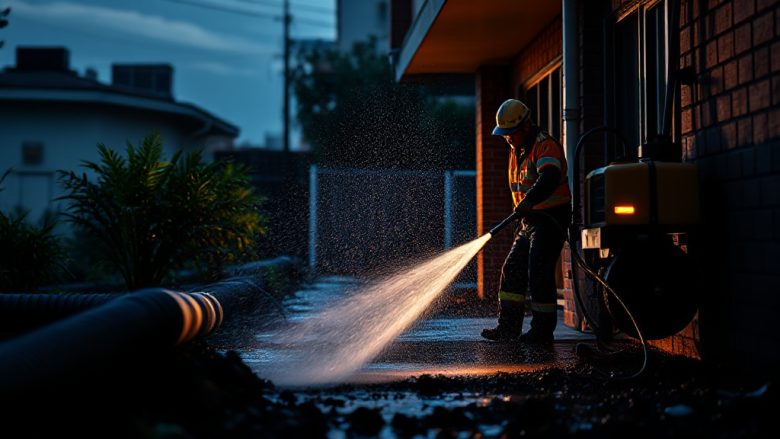
Hydrojetting uses high-pressure water, often between 1,000 and 4,000 psi, delivered through a flexible hose with a specialized nozzle. It scours the full interior of the pipe, removing grease, scale, silt, and roots rather than just punching a hole through the blockage. For Granja Julieta homes with recurring backups, shared building lines, or older pipes that have never been cleaned, hydrojetting is the only method that restores the pipe to its original diameter.
This is where a professional service matters. A desentupidora Granja Julieta team can inspect the line with a camera before jetting, confirm the pipe material and condition, and adjust pressure to avoid damage. Hydrojetting is not a DIY method: the equipment is heavy, the pressure is dangerous, and the wrong nozzle can crack a fragile pipe. It is also the method of choice for main sewer lines, restaurant grease traps, and condominium stacks.
What hydrojetting can and cannot fix
Hydrojetting clears grease, soap, scale, silt, and light roots. It cannot repair a collapsed pipe, a bellied line, or a severe root intrusion that has cracked the wall. In those cases, the camera inspection reveals the defect and the solution moves from cleaning to repair. For most Granja Julieta buildings, a preventive hydrojetting every one to two years is cheaper than emergency repairs after a backup.
Comparing the four methods side by side
Think of the decision as a ladder. The plunger handles soft, shallow clogs in a single fixture. The manual auger handles clogs past the trap in the first few meters of pipe. Chemical cleaners handle soft organic buildup but carry corrosion and safety risks. Hydrojetting handles the full pipe, including main lines, grease, scale, and roots, but requires professional equipment and a camera inspection to be safe.
| Method | Best for | Cannot handle | Skill level |
|---|---|---|---|
| Plunger | Soft clogs near the drain opening | Blockages past the trap | DIY |
| Manual auger | Hair and soft clogs in branch lines | Main lines, hard grease, roots | DIY with care |
| Chemical cleaner | Slow drains with organic buildup | Grease, roots, fully blocked lines | DIY, with safety limits |
| Hydrojetting | Grease, scale, roots, main lines | Collapsed or cracked pipes | Professional only |
If you have tried a plunger and an auger and the drain still backs up, the blockage is almost certainly in the main line or the building’s shared sewer. At that point, calling a desentupidora Granja Julieta São Paulo SP is not an overreaction; it is the correct next step. A professional team can inspect the line, choose between hydrojetting and mechanical cleaning, and confirm the pipe is sound before the problem returns.
The practical recommendation for Granja Julieta homeowners is simple. Keep a plunger and a manual auger at home for single-fixture clogs. Avoid chemical cleaners as a habit, especially in older buildings and homes with septic systems. When a clog returns in the same place, when multiple fixtures back up at once, or when water rises in the floor drain, stop improvising and bring in professional hydrojetting. That sequence saves money, protects your pipes, and solves the problem at its source rather than at the drain opening.