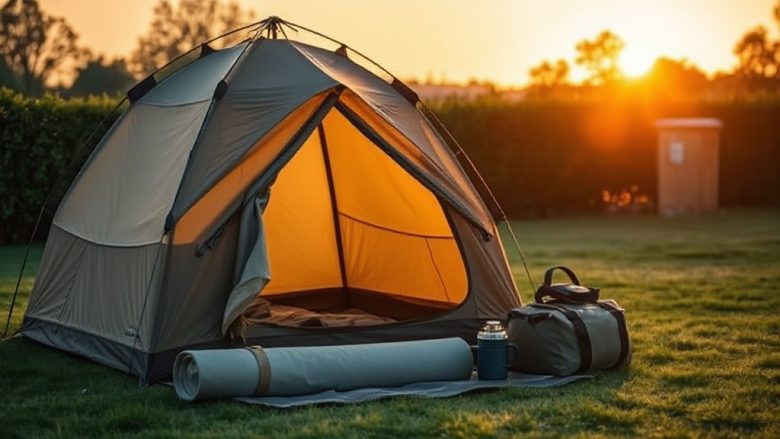
Here’s the smallest possible version of camping: one night, a campsite with toilets, and gear you didn’t buy. That’s it. You don’t need a roof tent, a folding kitchen, or a van with a name. You need a patch of grass, a sleeping bag that isn’t terrible, and the willingness to be slightly cold and slightly bored for a few hours. If you like it, you build from there. If you hate it, you’ve lost a Saturday and learned something useful about yourself. This guide on how to get started with camping is deliberately unglamorous, because the first trip shouldn’t be a test of your equipment. It should be a test of whether you enjoy sleeping outside. Everything else can wait.
Decide What Kind of Camper You Actually Are
Before you look at gear, decide what you’re signing up for. There are roughly three flavours of beginner camping, and they have very different demands.
Frontcountry camping means a drive-up pitch, usually in a managed campsite with toilets, taps, and a warden who checks on you. You park beside your tent. This is where almost everyone should start, and it’s where this article stays. The stakes are low because help is a short walk away.
Walk-in camping means you carry your kit a few hundred metres from the car park. It feels wilder, filters out the loudest neighbours, and still leaves you close to a toilet block. It’s a good second trip.
Backcountry camping means carrying everything on your back, treating your own water, and digging holes. It’s wonderful and it is not a first trip. Ignore it for now.
Ask yourself one honest question: do you want a holiday, or do you want a challenge? If the answer is a holiday, book a frontcountry pitch with a shower block and enjoy it without apology. There is no medal for suffering on your first night out.
Mini checklist for this phase: pick frontcountry for trip one; choose one night, not three; pick a date with a decent forecast; tell someone where you’re going.
Borrow Before You Buy Anything
The fastest way to waste money on camping is to buy a full kit before your first night. Tents, mats, and bags are the three things people overspend on, and all three are easy to borrow.
Ask around. Most people who camp have a spare tent in a loft, and most of them would rather lend it than watch you buy the wrong thing. Borrow a two- or three-person tent even if you’re going alone; a little extra room makes a first night much easier, and you’ll learn what size you actually want before spending anything.
For the sleeping bag, borrow or buy second-hand. Check that the zip runs smoothly and that there’s no damp smell. Ignore the temperature rating printed on the bag; it’s optimistic. If it says three-season, treat it as a mild summer bag and pack an extra layer.
For the sleeping mat, borrow a foam roll if you can. Foam is bulky but it never punctures and it’s warm enough for one night. Inflatable mats are more comfortable but they’re also the item most likely to fail at 2 a.m. on your first trip.
If you do end up buying, buy the mat first. A good mat matters more than a good tent. A cheap tent with a decent mat will give you a better night than an expensive tent with a thin foam square.
Mini checklist for this phase: borrow a tent, a bag, and a mat; borrow a stove or plan cold food; skip the gadget aisle entirely; write down what you borrowed from whom.
Book a Forgiving Campsite
The site you choose will decide whether your first trip feels easy or grim. A forgiving campsite has four things: toilets, drinking water, flat ground, and a short walk from the car.
Toilets matter more than you think. A first night is much less stressful when you’re not negotiating a bush at 3 a.m. Drinking water means you don’t have to carry litres from home. Flat ground means you won’t slide off your mat all night. And a short walk from the car means you can leave the heavy stuff behind and go back for the thing you forgot.
Look for a site that allows fires in a raised pit or a designated hearth, because a small fire is the single best way to make an evening outside feel like an event rather than a wait. If fires aren’t allowed, a small gas stove does the same job for a cup of tea.
Book early if you’re going on a weekend in summer. Popular sites fill up, and the pitches that remain are usually the sloped ones. If you can, go on a Sunday night or a weekday. Quieter sites are more forgiving for beginners because you’re not competing for the flattest spot or the cleanest shower.
Read the site rules properly. Some sites don’t allow tents over a certain size, some charge per person rather than per pitch, and some close their gates at a fixed time. Turning up after the gate is locked is a miserable way to start.
Mini checklist for this phase: confirm toilets and drinking water; check pitch size limits; check gate times; pick a site within an hour of home for trip one.
Pack Light, Pack Warm, Pack Dry
Your first pack should fit in the boot of a small car with room to spare. If you’re filling the whole car, you’re taking too much, and you’ll spend the evening moving things rather than sitting down.
Start with the sleep system: tent, bag, mat, and a pillow you actually like. A rolled-up fleece works fine as a pillow. Then add one change of warm clothes for the evening and one dry set for sleeping. Sleeping in the clothes you wore all day is a reliable way to be cold, because day clothes hold moisture.
Bring a headtorch. Not a phone torch. A headtorch leaves both hands free, which matters when you’re trying to find a zip in the dark. Bring spare batteries or a charging cable.
For food, keep it simple on trip one. A flask of hot water, a couple of sandwiches, something to boil for dinner, and a bag of something sweet. If you’re using a borrowed stove, test it at home in the garden first. Learning how the valve works in daylight is much easier than learning it in the dark with a hungry audience.
Then add the small things that make a night comfortable: a bin bag for rubbish, a cloth for wiping down, a small first aid kit, and a bottle of water you can keep beside your mat. A dry bag or a bin liner for your dirty clothes keeps the tent from smelling like a locker room by morning.
Mini checklist for this phase: sleep system plus one warm layer plus one dry layer; headtorch with spare power; simple food and a tested stove; bin bag, cloth, water bottle, basic first aid.
Arrive, Pitch, Sleep, and Leave No Trace
Arrive with at least two hours of daylight left. Pitching in the dark is the most common first-timer mistake, and it turns a calm evening into a stressful one.
Walk the pitch before you commit. Look for the flattest ground, check for tree roots and stones under where the tent will go, and note which way the ground slopes. A slight slope is fine if you sleep with your head uphill. A big slope is not, no matter how tired you are.
Pitch the tent with the door facing away from the prevailing wind if you can tell which way it’s blowing. Peg it out properly, even if it looks calm. Weather changes at night, and a flapping tent is a sleepless tent. If rain is possible, make sure the outer layer doesn’t touch the inner layer, because that’s how you get a wet sleeping bag.
Once you’re set up, eat before you get too cold. Warm food and a hot drink do more for your mood than any piece of gear. Then get into your sleeping bag before you feel tired, because lying in a bag warms it up, and a warm bag is much easier to fall asleep in than a cold one.
Expect to sleep badly. Almost everyone does on their first night. The ground feels harder than it does at home, the sounds are unfamiliar, and your brain keeps checking on things. That’s normal, and it doesn’t mean camping isn’t for you. The second night is usually much better.
In the morning, pack up slowly, check the grass where your tent stood, and take everything with you. Leave the pitch as you found it, or better. Food scraps attract animals, and a clean pitch is the mark of someone who’ll be welcomed back.
Mini checklist for this phase: arrive in daylight; choose flat ground; peg out properly; eat before you’re cold; sleep in dry layers; leave nothing behind.
If your first night is uncomfortable, that’s information, not failure. Change one thing next time: a better mat, a warmer bag, a quieter site, or a shorter drive. Camping gets easier fast once you know which part actually bothered you. You don’t need to be good at it. You just need to go once, and then decide.