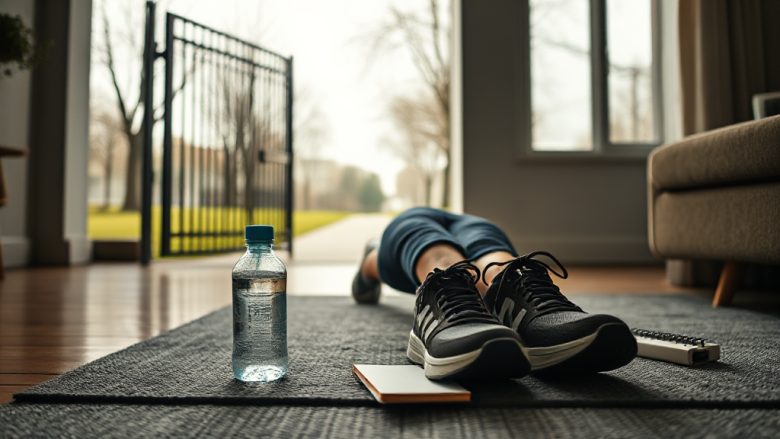
Motivation is expensive when you buy it. A gym membership, a smartwatch, a tub of pre-workout, a pair of shoes that cost more than your weekly food shop: none of that is motivation. It is spending. And spending is the easy part.
The harder, cheaper route is to make the next session so easy and so close that skipping it takes more effort than doing it. That is what fitness motivation on a tight budget really comes down to. Not willpower. Not a new app. Design.
I’ve trained in shared flats with a single kettlebell, in parks in the rain, and in a living room with a rug I had to roll up first. The months I trained consistently were never the months I spent the most. They were the months I removed the most friction. Here’s how to build that for yourself, using free and near-free options only.
Why Budget Fitness Fails Before It Starts
Most people quit not because training is hard but because the cost of entry is too high in every sense. Money, time, travel, decisions. When a workout requires a bus ride, a monthly fee, and a change of clothes, you are asking your future self to make five good decisions in a row. On a bad day, that stack collapses.
So the first job is to lower the cost of entry until it is almost embarrassing. Almost free. Almost instant.
Think about what a session actually costs you. If you train at home, the cost is zero pounds and roughly ten seconds of setup. If you train at a gym, the cost is a fee, a commute, a locker, and a queue for the squat rack. Both can work. But the home version wins on the days you feel flat, and flat days are the ones that decide whether you keep going.
Here is the reframe: you are not trying to feel motivated. You are trying to make the default option the training option. If your shoes sit by the door and your only piece of kit is already in the room, the lazy choice becomes the workout. That is a design decision, not a personality trait.
You do not need a home gym. You need a clear two-metre square of floor, a wall, and a chair. That covers push-ups, split squats, rows under a table, dips between two chairs, planks, and step-ups. Bodyweight training is not a consolation prize for people who can’t afford equipment. It is the original programme, and it scales from beginner to genuinely hard.
Free Structures That Do the Work for You
Motivation is unreliable. Structure is not. The trick is to borrow structure from things that already exist and cost nothing.
Parks are the most underused free gym in the country. Most have a rail for rows, a bench for step-ups and triceps dips, a slope for sprints, and open space for lunges. Go at the same time each week and you will start to notice the same faces. That is not a coincidence; it is a free accountability system you didn’t have to build.
Public stairs are another one. A flight of stairs, ten minutes, and a timer is a brutal conditioning session. No equipment, no fee, no booking. If you live near a hill, you have a treadmill that never breaks.
Then there is the structure of a fixed time slot. Pick three specific times in the week and treat them like appointments you cannot move. Tuesday at seven, Thursday at seven, Saturday at ten. Write them somewhere visible. The point is not discipline; it is that a scheduled session requires no decision. You are not choosing to train. You are just showing up to a thing that was already in the diary.
One more free structure: pair training with something you already do. Walk to the shop the long way. Do ten push-ups before every shower. Squat while the kettle boils. These are not a workout. They are reminders that movement is normal, and normal is what you’re aiming for.
People Are Cheaper Than Equipment
The single best piece of free fitness kit is another person.
A training partner costs nothing and does more for consistency than any gadget. You will skip a solo session far more readily than one where someone is waiting for you. Even a weekly walk with a friend counts. The point is that someone notices whether you turned up.
If you don’t have a partner, use a cheap or free group. Parkrun-style community runs are free and open to all paces. Local walking groups often cost nothing. Community centres sometimes run low-cost classes, and libraries and noticeboards are still good places to find them. You are not looking for the best programme. You are looking for a recurring time and a few familiar faces.
There is a second kind of accountability that costs even less: tell someone your plan. Not vaguely. Specifically. “I’m doing three sessions this week, Tuesday, Thursday, Saturday.” Then report back. That tiny social contract does more than a paid subscription ever will, because you cannot quietly abandon a promise you said out loud.
And if you’re the competitive type, a free challenge with a friend works wonders. Most steps in a week. Most sessions in a month. First to fifty push-ups. Keep it simple, keep it free, keep it going.
Tracking Progress Without Paying for Apps
You do not need a subscription to know whether you are improving. You need a pen.
A notebook and a cheap pen will out-perform most fitness apps because they force you to write down what you actually did. Three columns: date, what you did, and one number that moved. That number could be reps, seconds, distance, or how hard it felt out of ten. Over a month, that page becomes proof. Proof beats motivation every time, because motivation is a feeling and proof is a fact.
If you want something on your phone, use the free tools already on it. A basic notes app, a stopwatch, a calendar reminder. That is a complete tracking system. You do not need a heart-rate strap to know you worked hard. You know.
Weighing progress in other free ways helps too. How do your trousers fit? Can you climb the stairs without getting winded? Can you do one more push-up than last month? These are honest measures, and they cost nothing.
One caution: don’t track everything. Pick one or two numbers and leave the rest alone. Tracking too much turns a simple habit into a spreadsheet, and spreadsheets are where motivation goes to die.
A Weekly Template You Can Start This Week
Here is a week that costs nothing but time. Adjust it to your life, not the other way round.
Monday: twenty minutes at home. Five minutes of easy movement to warm up, then three rounds of push-ups, squats, and a plank. Rest as needed. Done.
Tuesday: a walk. Thirty to forty minutes at a pace where you can talk but not sing. This is not a rest day; it is a recovery day that still counts.
Wednesday: park session. Find a bench and a rail. Step-ups, rows, dips, lunges. Three rounds. If it’s raining, do it at home instead. The weather is not a reason; it is a variable.
Thursday: stairs or hills. Ten to fifteen minutes of hard efforts with easy walking between. Short and unpleasant. Perfect.
Friday: rest, or a gentle stretch while the kettle boils.
Saturday: the long one. A longer walk, a run, a bike ride, or a community session. This is the session you look forward to, so make it something you enjoy.
Sunday: off. Genuinely off. Recovery is free and it is part of the plan.
Notice what is missing. No fees, no equipment, no app, no commute. The whole week runs on a pair of shoes, a notebook, and three fixed time slots. That is the entire budget.
The reason this works is not that it is clever. It is that it removes the excuses before they arrive. You cannot forget your gym kit if there is no gym kit. You cannot talk yourself out of a commute if there isn’t one. You cannot decide to skip if the decision was made on Sunday when you wrote the week down.
So here is the challenge, and it is a small one. Tonight, put your shoes by the door. Write three times in your diary for the coming week. Pick one number to track. That’s it. Do that, and you have already solved the money problem and most of the motivation problem in one go.
Motivation on a tight budget is not about wanting it more. It is about making it easier to start than to skip. Build the environment, keep the cost at zero, and let the routine carry you on the days your feelings won’t.