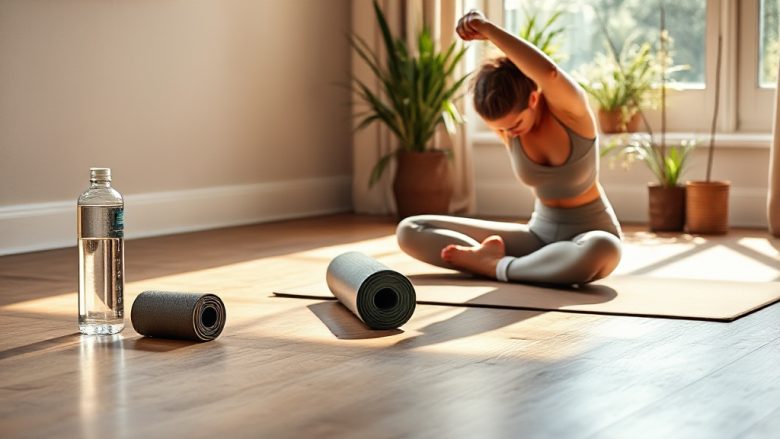
Most stretching advice fails because it answers the wrong question. Someone asks whether they should stretch before a run, and they get a lecture on muscle spindle fibres. Someone asks why they still can’t touch their toes after a month of daily hamstring stretches, and they’re told to just hold longer. Neither answer helps. So here are the questions people actually ask about stretching and mobility, answered in plain language, without the physiology detour. No overpromising. No pretending a five-minute routine will undo eight hours in a chair.
Do I need to stretch before exercise?
Probably not the way you think. Static stretching, where you hold a muscle still for 30 seconds or more, temporarily reduces the force that muscle can produce. If you do a long hamstring stretch and then immediately sprint, you’re slightly weaker for the next few minutes. That’s not a disaster, but it’s not helpful either. What your body actually wants before movement is a warm-up: light activity that raises blood flow and rehearses the patterns you’re about to use. A brisk walk, some arm circles, a few bodyweight squats. Save the long holds for after, when your muscles are warm and you’re not about to ask them for peak output.
If you enjoy a gentle stretch before training because it helps you feel ready, that’s fine. Feeling ready matters. Just keep it short and easy, maybe 10 to 15 seconds per area, and don’t chase a deep end range right before you need strength. The old idea that you must stretch cold muscles to prevent injury doesn’t hold up well. Most injuries happen from doing too much too soon, not from skipping a toe touch.
Takeaway: warm up to move, stretch to recover.
How long does it take to get more flexible?
Longer than the internet suggests, and less than you fear. Noticeable changes in a single muscle group usually take several weeks of consistent work, not days. If you stretch your hamstrings three or four times a week for a month, you’ll likely feel a difference in how far you can reach. But here’s the catch: much of that early gain is your nervous system tolerating a longer position, not your muscle tissue physically lengthening. That’s still real progress. It just means the first improvements come faster than the later ones.
Genetics play a bigger role than most people admit. Some bodies are built with more joint range and softer connective tissue. Others are naturally stiffer. If you’ve been stiff your whole life and your friend can fold in half after two weeks, that doesn’t mean you’re doing it wrong. It means you’re different people. Compare yourself to your past self, not to someone else’s highlight reel. And be honest about consistency. Ten minutes twice a week beats an ambitious hour once a fortnight, every time.
Takeaway: expect weeks, not days, and measure your own progress.
What’s the difference between stretching and mobility?
Stretching is about length. Mobility is about controlled movement through a range you already have, or are working to own. You can be extremely flexible and still have poor mobility if you can’t control that range. Think of someone who can do a full split but can’t lift their leg slowly and hold it there without wobbling. The tissue is long, but the strength and coordination at the end of that range aren’t there. That distinction matters because it changes what you should practise.
Mobility work looks like slow, deliberate movement: a deep lunge with a gentle rock, a controlled hip circle, a shoulder rotation you actually steer rather than fling. You’re teaching your joints and muscles to work together through the range, not just passively hanging out at the end of it. For most everyday goals, like reaching overhead without shrugging, getting off the floor without hands, or squatting to pick something up, mobility training gives you more return than pure stretching. It’s active, it’s specific, and it transfers to real movement.
Takeaway: if you can’t control the range, you don’t own it yet.
Should I stretch if it hurts, and how often should I actually do this?
There’s a difference between a stretch sensation and pain. A good stretch feels like tension, warmth, maybe a mild pull that eases as you settle in. Pain is sharp, shooting, burning, or electric. If you feel that, back off immediately. Numbness or tingling down a limb is a red flag too, and it’s worth getting checked rather than pushing through. The old no-pain-no-gain line has caused a lot of unnecessary strain. Discomfort at the edge of your range is normal. Pain is your body telling you to stop, and it’s usually right.
As for frequency, most people do well with a short daily dose of movement rather than a long weekly session. Five to ten minutes most days, focusing on the areas that feel tight from your actual life, will do more than an hour of intense stretching on Sunday. If you sit a lot, your hips and upper back probably need attention. If you run, your calves and hamstrings will thank you. Keep it boring and regular. The best routine is the one you’ll still be doing in three months, not the one that looks impressive for a week.
Takeaway: tension is fine, pain is a stop sign, and daily beats heroic.
Why does stretching sometimes not work at all?
Because the tightness you feel might not be a length problem. A muscle can feel tight because it’s weak, because it’s guarding a joint that feels unstable, or because your nervous system has decided that range isn’t safe today. Stretching a weak muscle that feels tight often makes it feel tighter, because you’re pulling on tissue that’s already working hard to protect you. This is why some people stretch their hamstrings for years and never get anywhere. The hamstrings aren’t short. They’re doing a job, usually because the hips or core aren’t pulling their weight.
If a stretch isn’t giving you lasting change after a few weeks, stop and ask a different question. What else is going on around that area? Can you control the joint above and below it? Does the tightness change with your stress levels, your sleep, or how much you’ve been sitting? Often the fix is strengthening something else, or simply moving more throughout the day, rather than stretching harder. Your body isn’t a rubber band. It’s a system, and it responds to load, rest, and confidence as much as it responds to length.
Takeaway: if stretching hasn’t worked, the problem probably isn’t length.
Do I have to stretch forever to keep my range?
Not forever in the way people fear, but you do have to keep moving. Range you don’t use tends to shrink, especially as you age and your daily habits narrow. If you spend your twenties sitting at a desk and your forties doing the same, your hips will gradually lose the range you never asked for. But maintenance is far cheaper than gain. Once you’ve built a comfortable range, a few minutes a couple of times a week is often enough to hold onto it, provided your general life includes varied movement: walking, stairs, getting up and down from the floor, reaching and carrying.
The people who stay mobile into their seventies and eighties usually aren’t doing elaborate routines. They’re gardening, walking, lifting grandchildren, squatting to pick things up, and generally using their bodies across a wide range every day. That’s the real secret, and it isn’t much of a secret. Stretching and mobility work is a top-up, not the whole meal. Use it to fill the gaps your daily life leaves, and you won’t need to treat it as a lifelong chore. You’ll just keep moving, and your body will follow.
Takeaway: build range, then maintain it with movement you barely notice.